4/2/14

Exercise 4 (Edited) - Panpan Deng
Here is my edited Exercise 4 - Reversed Sand-glass.
The top glowing ellipse could be see as a black-hole where time can be reversed. If regular sand-glass measures the time we lost, then could the "reversed" sand-glass be a tool to gain time?
The top glowing ellipse could be see as a black-hole where time can be reversed. If regular sand-glass measures the time we lost, then could the "reversed" sand-glass be a tool to gain time?
Exercise 4 (edit)-Lauren Arnold
Here is the link to my clock edit! I decided to take everyone's advice and have the actual clock take up more space and have less of an empty canvas. I decided to change the milliseconds coding to be still a black outline, but now with an empty fill. The seconds are now red to evoke the idea of a more intense message- more engrained coloration within our minds. The minutes are now white, and the hours are now black. The black and white tones are still to give of this very mechanical idea of time. I changed the background to be completely white all together so that there is still this kind of empty loneliness we find in ourselves when stuck in the mechanics of time still prominent.
The sizes of the shapes also have an influence. The milliseconds are smaller in length and thickness, as are the seconds to the minutes, and the minutes to the hours. Yet the coloration and the no fill on the milliseconds I think have a much more lasting impact in my message than how the clock was formulated before.The larger increments of time paint over with thickness, size, and color over the smaller increments at first. But then the smaller increments of time prevail and paint over the larger increments-furthering my concept that small moments of time are what we focus on- unfortunately not the large picture. We are all so caught up in only the present millisecond, and second- we forget to formulate our own memories in the bigger moments of time.
The milliseconds still erase the seconds, the seconds still erase the minutes, and the minutes continue to erase the hours. The differences in coloration make the memory of each increment of time more long lasting. I love that the milliseconds tricks you as you think that they are not very important because there is no fill of color. But then the milliseconds become dominant again-forming an all black circular figure. Yet, then the seconds tries to erase the milliseconds, yet the smaller increment of the milliseconds in time prevails- similar to how we let the short moments erase the longer moments of the big picture of our lives in time.
4/1/14
Exercise 4 (edited) - Lauren Owensby
I updated my clock!
The link to download the zip file is here.
I added an am/pm switch, a radio dial to represent minutes passed, added sound waves that react to the song "Dance of the Hours" by Amilcare Ponchielli, and added more times when the eyelids close. Eyelids will be completely closed after midnight and before 6 am. They gradually close near midnight and open after 6 am.
I used 5 sound wave lines to replicate the musical staff. If you right click on the mouse in the processing window (does not work in the browser yet because of W drive) a "note" will appear which you can drag all over the screen, including on the staff.
Web Log as Durational Performance - Examples
Durational Artworks:
Durational Blog Projects:
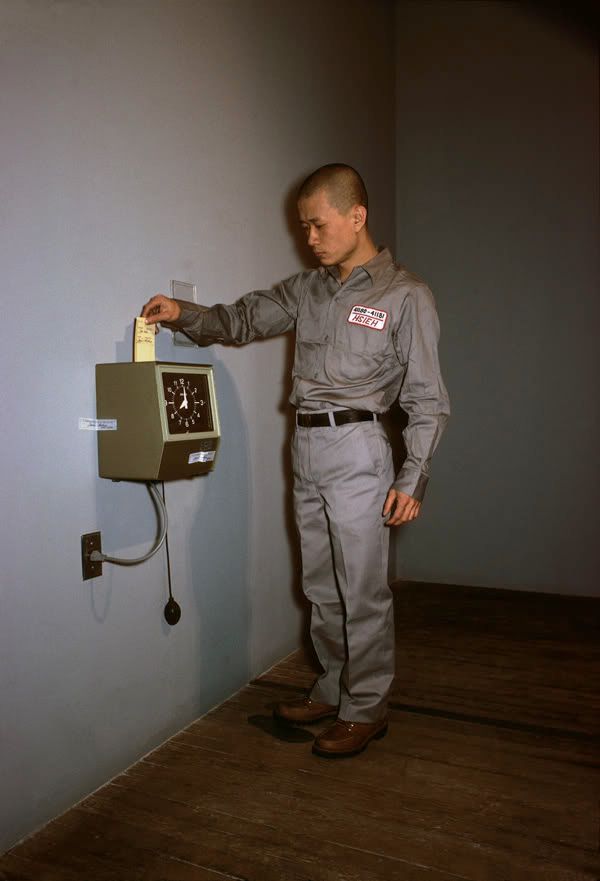
- Tehching Hsieh - One Year Performances: Cage Piece and Time-clock Piece
- Time Clock Piece still
- artist talk (Part 2)
- promo
- gallery screening
- Cage Piece still
- Marina Abramovic - The Artist is Present
- On Kawara - Today series, One Million Years
- Industry of the Ordinary - Well Groomed
- Andrea Zittel - Free Running Rythms and Patterns (4:50)

Durational Blog Projects:
- Lawrence Dai - The Lawrence Julie and Julia Project
- The Lolvantgarde
- Joe Pankowski - Joe's Drawing a Day
Other blog concepts:
- Bread People
- True American Dog
- A. Bill Miller - Grid
- Teenage Mutant Ninja Noses
Subscribe to:
Posts (Atom)